



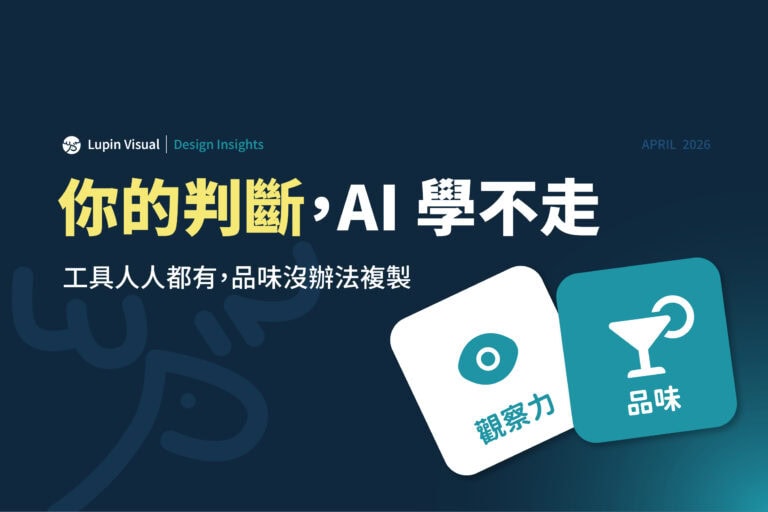
AI amplifies what you type, it amplifies judgment if you have it, and it amplifies blankness if you have no brain. This article talks about what designers really can't learn in the age of AI: observation, taste, and the ability to say no.Anyone who can use AI is the same, so what?
AI is fast and the output is getting better.
It amplifies what you've entered.
If you have judgment, it amplifies judgment; if your head is empty, it amplifies blankness.
The upper limit of the tool is the upper limit of the user.
Dan Koe says, "There must be something about you that won't be completely replaced. Some combination - your taste, your judgment, the way you see things. Your job is to find that thing."
I think this is the most similar statement I have seen so far.
There's a market for mediocrity, but you don't have to be buried with it.
Many design jobs in Taiwan do not have much room for thinking.
Pressure on time, pressure on scripts, pressure on prices.
The final product is not a design at all, but a rush job.
Haven't you ever heard that all for one is all for none? There's no such thing as both.
(Listen up.Garbage time for garbage.。)
And then the AI came.
Not only did it accelerate the cycle, but it also disrupted what was thought to be a stable rule: having a skill would allow you to work steadily for the rest of your life. This logic has held true for a long time. Now that these skills have become less scarce overnight, the old ways are immediately worthless.
But the question is not whether the market is mediocre, the question is whether you want to be mediocre with it.
Designers should be world watchers.
Observation is the most important thing to me.
A designer is not just someone who makes things beautiful, he should be someone who can see the bottom half of the iceberg, to see how people act, how the medium affects perception, and what logic the market is playing behind.
Paul Rand in Thoughts on Design says, "A designer doesn't start with a preconceived idea. Ideas should be the result of careful study and observation, and design is the product of that idea.
It was written in 1947. But now it has become even more important.
Steve Jobs said, "Creativity is about connecting things. When you ask a creative person how he did it, he's kind of embarrassed because he didn't really do anything, he just saw something."
The more one understands the human experience, the better the design will be.
This is the compound interest of observation. The more you see, the more points you can connect. Your experience in taking cases, your feelings in shopping at exhibitions, the books you read, the places you've been, etc., are all accumulating a knowledge base in your brain; AI can't do these things for you.
For example Typography The evolution of trends is part of this accumulated knowledge base.
Three Judgments
If observation is the bottom line, then the designer's job is to make three kinds of judgments from those observations.
Explosion Point: Creating Tension
You need to know how to make tension to make people stop.
The designer sees something that no one else sees, a certain contradiction, a certain contrast, and then magnifies it. It's not enough for one person to see it, it's only valid if a stranger who stops in front of the painting for three seconds also feels it.
Concept: Know Why
You have to know why this thing exists.
AI can put elements together, but it's you who decides if the combination is worthwhile. The difference is in the "why", who it's speaking to, the context in which it appears, and how it's going to make people feel. The "why" is the result of the potholes you've stepped in, not the AI.
Trade-offs: Design as Subtraction
You have to know how to make choices and accept what is good.
AI always gives you more. More options, more versions, more variants.
But the value of a human being lies in knowing what to take away, where to leave white space, where to remove, and where no explanation is needed.
Can you imagine Song Hye Kyo's eyes + Jeon Ji Hyun's nose + Son Ye Jin's mouth together?
I don't dare to look at my own group, hahaha.
(When working on a project, the hardest part is never what to think of, it's deciding what not to put in. It's a tug-of-war with myself every time.)
Your perspective is the only thing the AI can't duplicate.
So I'm becoming more and more convinced of one thing: AI can help you think faster. But it can't help you think deeper.
Your tastes change, your judgment changes, and the way you see the world changes.
The one who will change is the one who is really designing.
The tools will change and the medium will increase.
But the person who can decide "white space here, tension here, take away here" will not be replaced.
I'm still practicing, so let's encourage each other.
Frequently Asked Questions (FAQ)
A: Yes, but the needs are different. The design at the executive level is shrinking, and the design needs at the judgment level remain the same. The question is where you stand.
A: There is no shortcut, it is to see a lot, touch a lot, and then force yourself to say "this is better than that", and explain why. Taste is the accumulation of choices, not feelings.
A: At first glance, it's getting harder and harder to tell the difference. But after looking at them for a long time, you will feel that each picture is similar, not particularly bad, and not in your own style. The "feeling of similarity" is the operation of taste.
A: Stop selling execution and start selling judgment. Your observation, your network, your choice, those are AI can not give.
A: Yes. Go to exhibitions, read things that are not in your area of expertise, record visuals or words that you feel "something" about, and then explain why there is something there. If you do this long enough, you'll naturally make more connections.